The OSINT Operating System Problem: Why Modern Investigations Need Unified Workflows
Modern investigations are fragmented across tools. A unified workflow reduces context loss, preserves evidence integrity, and makes reporting faster and more reliable.
Published
17 mai 2026
Updated
17 mai 2026
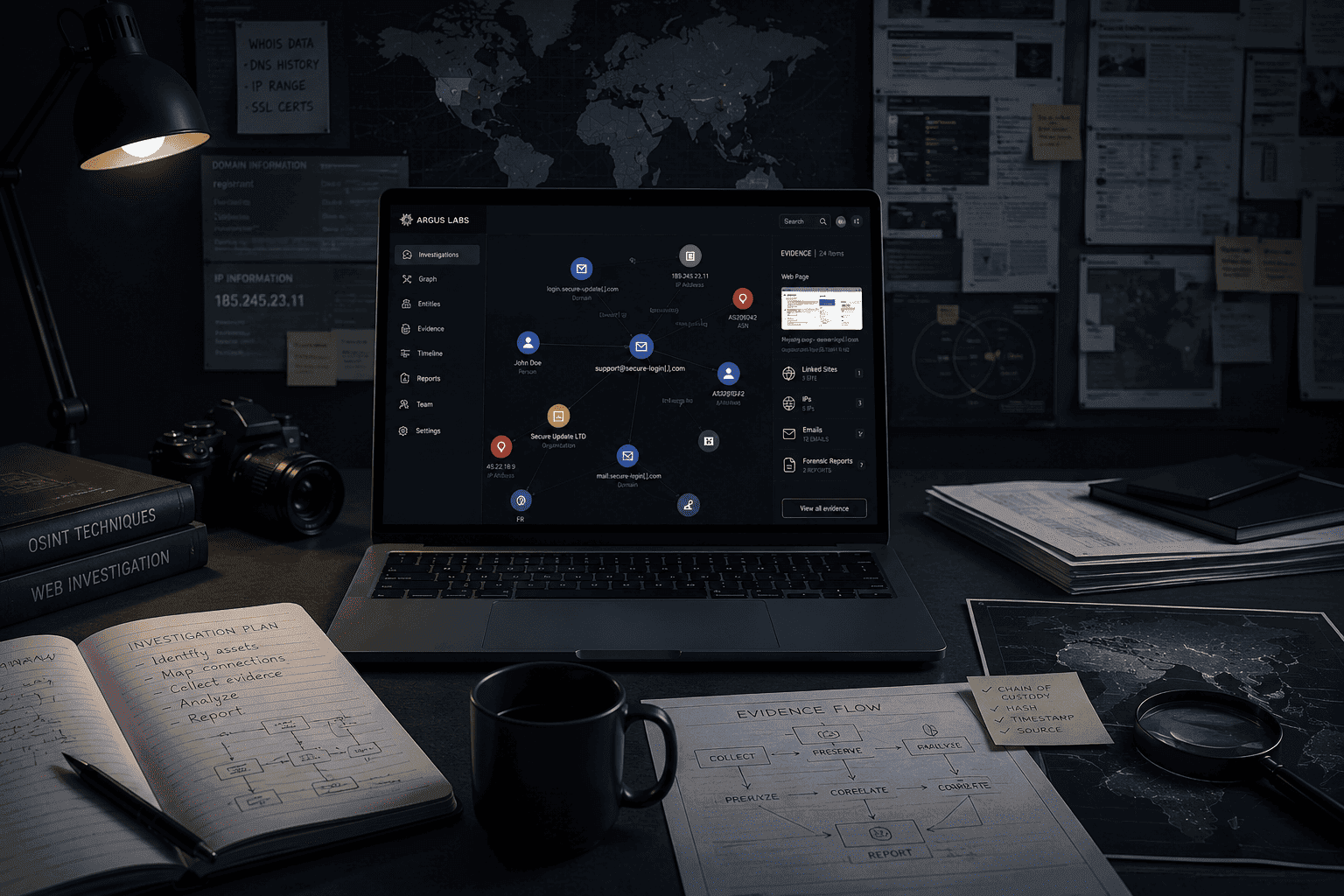
Online investigations have become increasingly fragmented.
Analysts jump between screenshot tools, note-taking apps, browser extensions, spreadsheets, graphing software, enrichment platforms, PDF generators, and evidence archives, often during a single investigation.
The result is operational chaos:
- Context gets lost
- Evidence becomes difficult to trace
- Workflows become inconsistent
- Reporting consumes more time than the investigation itself
- Collaboration becomes painful
- Investigators spend more time managing tools than analyzing intelligence
This fragmentation is one of the biggest hidden problems in modern OSINT and cyber investigations.
The Modern Investigation Stack Is Broken
A typical investigation workflow today may involve:
- Capturing evidence from websites and social media
- Archiving pages before deletion
- Extracting entities manually
- Building relationship graphs in another tool
- Storing notes separately
- Exporting screenshots manually
- Writing reports in Word or Google Docs
- Attempting to preserve evidence integrity throughout the process
Each step introduces friction.
More importantly, every tool switch increases the risk of losing metadata, breaking investigation context, duplicating work, or creating inconsistencies in reporting.
Most investigators are not lacking tools.
They are lacking workflow continuity.
Why Context Preservation Matters
In investigations, isolated evidence has limited value.
Context is what transforms raw data into actionable intelligence.
A screenshot alone is not enough.
Investigators need:
- source attribution
- timestamps
- relationships between entities
- investigation chronology
- enrichment history
- analytical reasoning
When information is scattered across multiple disconnected platforms, reconstructing that context later becomes difficult.
This becomes especially problematic in:
- phishing investigations
- fraud investigations
- corporate intelligence
- digital forensics
- threat intelligence
- legal review workflows
Selected References
If you want a few official points of reference around the tools and concepts mentioned above:
- Argus Labs for the investigation workspace behind this editorial direction
- Internet Archive for durable web archiving
- Maltego for link analysis and investigative graph work
- Google Docs for collaborative reporting
The Rise of Unified Investigation Platforms
The next generation of OSINT tooling is moving toward unified investigative environments.
Instead of treating collection, analysis, graphing, and reporting as separate phases handled by different tools, modern platforms increasingly consolidate them into a single workspace.
This changes the role of the investigator.
Rather than acting as a coordinator between disconnected systems, analysts can focus on:
- discovering relationships
- validating evidence
- identifying patterns
- producing intelligence
A unified workflow reduces cognitive overhead and improves investigation consistency.
What an Investigation Operating System Should Provide
An effective investigation platform should support the full lifecycle of an investigation.
1. Evidence Collection
The ability to capture and archive web content reliably.
This includes:
- screenshots
- metadata
- URLs
- timestamps
- page snapshots
- structured evidence storage
2. Relationship Analysis
Investigations often revolve around entity correlation.
Domains, emails, usernames, phone numbers, crypto wallets, IPs, and social accounts rarely exist in isolation.
Graph analysis allows investigators to visualize hidden connections and uncover operational infrastructure.
3. Centralized Notes and Intelligence
Analytical observations should remain attached to the investigation itself.
Notes disconnected from evidence quickly become difficult to interpret later.
4. Reporting
Reporting should not require rebuilding the investigation manually.
A modern workflow should allow investigators to generate structured reports directly from collected evidence and analytical findings.
5. Workflow Integrity
Maintaining investigation integrity is critical.
This includes preserving:
- chronology
- evidence provenance
- entity relationships
- analytical traceability
Why Tool Sprawl Slows Investigations
Many analysts underestimate the hidden cost of fragmented tooling.
The issue is not simply inconvenience.
Tool sprawl creates:
- slower investigations
- inconsistent methodologies
- duplicated evidence
- reduced collaboration
- higher operational complexity
It also increases onboarding difficulty for teams.
When investigations depend on ten disconnected tools and undocumented workflows, scaling becomes extremely difficult.
The Future of OSINT Workflows
OSINT is evolving rapidly.
Investigations are becoming:
- more data-intensive
- more collaborative
- more visual
- increasingly operationalized
The future likely belongs to platforms capable of combining:
- evidence capture
- graph intelligence
- investigation management
- enrichment
- reporting
inside a unified investigative environment.
This is the same evolution that occurred in:
- software development
- security operations
- digital design workflows
Fragmented ecosystems eventually consolidate into operational platforms.
OSINT appears to be following the same path.
Argus Labs is building that direction into a focused investigation workspace, with evidence capture, graph analysis, and reporting designed to stay in one place instead of being split across tools.
Building Better Investigation Workflows
The goal of modern investigation tooling should not simply be adding more features.
The real objective is reducing friction between:
- collection
- analysis
- intelligence generation
- reporting
Investigators should spend less time managing infrastructure and more time uncovering intelligence.
That requires workflows designed around continuity rather than fragmentation.
Final Thoughts
The problem facing many OSINT analysts today is no longer access to data.
The internet already provides more information than investigators can realistically process.
The real challenge is organizing investigations coherently.
As investigations become more complex, workflow architecture becomes increasingly important.
The platforms that succeed over the next few years will likely be those capable of transforming fragmented investigative processes into unified operational systems.
Learn more at Argus Labs, the investigation workspace designed to unify evidence collection, graph analysis, and reporting into a single workflow.
If you are interested in modern investigative workflows, follow the project for future articles, case studies, and product updates.